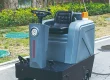
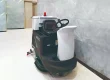
Choosing between a walk-behind scrubber, a ride-on scrubber, or a ride-on sweeper often comes down to one number facility managers actually plan around: how many square meters can this machine clean in an hour? Below is a side-by-side comparison built directly from OLIFT’s published machine specifications — no estimates, no rounding up.
Floor Scrubbers: Walk-Behind vs. Ride-On
| Model | Type | Cleaning Width | Cleaning Efficiency | Recovery Tank | Noise Level |
|---|---|---|---|---|---|
| EN500H | Walk-behind | 500 mm | 3,000 m²/h | 65 L | <65 dBA |
| EN700S | Ride-on (single brush) | 700 mm | 3,000 m²/h | 84 L | <65 dBA |
| EN870D | Ride-on (double brush) | 870 mm | 3,900 m²/h | 100 L | <65 dBA |
| EN760 | Ride-on (double brush) | 760 mm | 4,100 m²/h | 100 L | <60 dBA |
| EN900 | Ride-on (double brush) | 900 mm | 6,300 m²/h | 160 L | <60 dBA |
| EN860 | Ride-on (single brush) | 860 mm | 6,500 m²/h | 160 L | <60 dBA |
What the numbers show:
- Walk-behind (EN500H) and entry ride-on (EN700S) post the same 3,000 m²/h ceiling despite the ride-on carrying a larger 84 L tank — at this size class, brush width is the limiting factor, not seating.
- Moving to a dual-brush ride-on roughly doubles throughput. The EN860 and EN900, both in the 860–900 mm width class, clear 6,300–6,500 m²/h — more than double the entry-level machines.
- Tank capacity scales with width, not the other way around. Every step up in cleaning width comes with a matching jump in recovery tank size (65 L → 84 L → 100 L → 160 L), so operators don’t lose runtime to more frequent water changes as coverage increases.
- Larger machines run quieter, not louder. The 860–900 mm ride-on units are rated below 60 dBA, versus <65 dBA on the compact models — a function of these units being engineered for continuous multi-hour shifts.
Ride-On Sweepers: A Different Order of Magnitude
Sweepers cover far more ground per hour than scrubbers because they don’t need to lay down cleaning solution or dry the floor — they lift and contain dry debris in a single pass.
| Model | Cleaning Efficiency | Noise Level |
|---|---|---|
| SP1250 | 6,000–8,000 m²/h | <65 dB |
| SP1350 | 7,000–8,500 m²/h | <65 dB |
The SP1250’s product page also states a full-charge coverage range of 40,000–60,000 m² on a single charge — useful for estimating how many charge cycles a shift actually needs on a given warehouse footprint.
How to Read These Numbers for Your Facility
- Match cleaning width to aisle width, not just floor area. A wider brush moves more m²/h in open areas but loses that advantage in narrow aisles where it can’t run at full width.
- Tank size sets your realistic runtime, not just the headline m²/h. A machine rated at 6,500 m²/h that needs a tank refill every 30 minutes may cover less ground per shift than a steadier mid-size unit — check recovery tank capacity against your facility’s actual dirt/water load.
- Sweepers and scrubbers solve different problems. If the floor only needs dry debris removal (packaging waste, dust, grit), a sweeper’s 6,000–8,500 m²/h range will outperform any scrubber. If the floor needs washing and drying in one pass, compare within the scrubber table above.
For a full breakdown of how these throughput numbers translate into labour-cost savings and payback period, see our manual cleaning vs. ride-on floor scrubbers ROI comparison.
Browse the complete ride-on floor scrubber range and industrial floor sweeper range, or request a quote for the model that matches your facility’s floor plan.