Last updated: September 2026
When facility managers compare floor-cleaning options, the price tag on the machine is the least important number on the page. The number that actually decides the budget is Total Cost of Ownership (TCO) — what it costs to keep 10,000 m² of floor clean, every single day, for the next five years. This article compares manual mopping, walk-behind scrubbers and ride-on floor scrubbers using industry-standard productivity benchmarks, and shows why the ride-on machine that looks expensive is almost always the cheapest option on the balance sheet.
The Hidden Cost of Manual Cleaning
Manual cleaning looks free because the mop is already in the closet. In reality, labour accounts for 80–90% of the total cost of floor care, and mopping is the most labour-intensive method ever invented. A single cleaner with a mop and bucket covers roughly 200–400 m² per hour on a good day — and that figure drops sharply on large open floors where workers spend more time walking back to the bucket than actually cleaning.
Three cost drivers are routinely underestimated:
- Labour intensity: A large distribution centre may need a five- or six-person night crew just to mop the same floor a single operator can scrub in two hours.
- Inconsistent chemistry: Mop water becomes dirty within minutes. Operators compensate by pouring in more detergent, which leaves sticky residue that attracts new dirt — a textbook example of re-cleaning the same square metre twice.
- Safety and turnover: Repetitive mopping causes strain injuries, and high staff turnover means constant re-training. Slip-and-fall incidents on damp, unevenly mopped floors add insurance and liability costs that never appear on a cleaning invoice.
Productivity Benchmarks: How Much Floor Can Each Method Clean?
The table below uses productivity ranges published by cleaning-industry associations and equipment manufacturers. The reference facility is a 10,000 m² indoor floor cleaned once per day, 300 days per year, with a fully-loaded labour rate of US$18 per hour.
| Cleaning method | Working width | Productivity (m²/h) | Hours per 10,000 m² | Labour cost / day | Annual labour cost |
|---|---|---|---|---|---|
| Manual mop & bucket | 40–60 cm | 200–400 | 40 h | $720 | $216,000 |
| Walk-behind scrubber | 50–70 cm | 1,500–2,500 | 5 h | $90 | $27,000 |
| Ride-on scrubber | 70–110 cm | 4,000–8,000 | 2 h | $36 | $10,800 |
*Annual labour assumes 300 cleaning days at US$18/hour fully loaded. Machine productivity depends on floor condition, layout and operator skill.
The productivity gap is not incremental — it is structural. A ride-on scrubber cleans 12–25× more floor per hour than a mop. Move from manual cleaning to a ride-on machine and the annual labour bill for this facility falls from $216,000 to $10,800 — a saving of more than $205,000 every year, before a single consumable is counted.
Building a Total Cost of Ownership Model
A credible TCO model has to include everything, not just the invoice price:
- Acquisition: purchase price, batteries, charger, squeegee and brush tooling.
- Labour: hours × hourly cost, including supervision and re-training.
- Consumables: detergent, pads and brushes, and replacement mop heads.
- Water & energy: mopping typically consumes more water per square metre than a metered scrubber.
- Maintenance: scheduled service, wear parts, downtime and lost productivity.
Applying those lines to the same 10,000 m² facility over a five-year horizon produces a striking result:
| 5-year cost component | Manual mop | Walk-behind scrubber | Ride-on scrubber |
|---|---|---|---|
| Equipment (one unit) | $800 | $8,000 | $20,000 |
| Labour (300 days × 5 years) | $1,080,000 | $135,000 | $54,000 |
| Chemicals & consumables | $30,000 | $12,000 | $9,000 |
| Maintenance & wear parts | $5,000 | $15,000 | $18,000 |
| Total 5-year TCO | $1,115,800 | $170,000 | $101,000 |
| Cost per m² cleaned | $0.074 | $0.011 | $0.007 |
Why the Payback Is Faster Than You Think
Because labour dominates the equation, the payback period on a ride-on scrubber is measured in days, not years. Replacing manual mopping with a ride-on machine saves roughly $684 per day in this facility. Against a $20,000 machine, the investment is recovered in about 29 operating days. Even the incremental upgrade from a walk-behind to a ride-on model — an extra $12,000 — pays for itself in around seven months of daily operation. After that, every hour the machine runs is pure operating profit.
Quality, Safety and Consistency: The Non-Financial ROI
The financial case is only half the story. Automated scrubbing also delivers operational benefits that never show up in a labour spreadsheet:
- Consistent results: Recirculating brush systems apply fresh, metered solution at constant pressure, so the tenth thousand square metre is cleaned as well as the first.
- Lower chemical and water use: Metered dosing instead of hand-mixed buckets typically cuts detergent consumption by 30–50% and reduces waste water volume.
- Safer floors: Squeegee vacuuming removes the water film that makes hand-mopped floors a slip hazard.
- Happier, more stable crews: Operators drive instead of stooping, which reduces injury claims and staff turnover.
When Manual Cleaning Still Makes Sense
To be fair, mopping has not disappeared. Manual methods remain the right choice for small areas under roughly 500 m², congested corners and stairwells a machine cannot reach, spill response, and delicate surfaces where water volume must be tightly controlled. The mistake is using manual cleaning as the default method for large open floors, where it is provably the most expensive option available.
Matching the Machine to the Facility
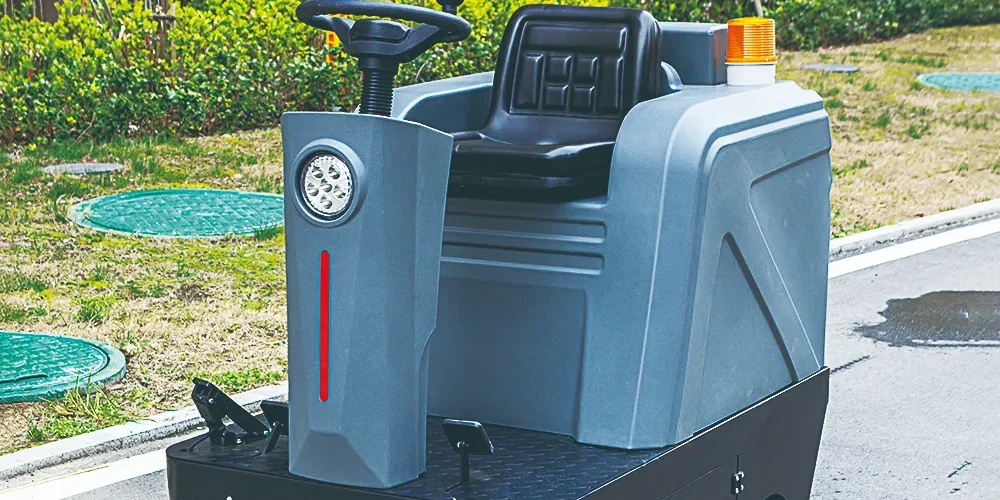
OLIFT builds ride-on machines around large-area TCO problems. The EN700S Ride-On Floor Scrubber pairs a 700 mm scrubbing deck with a high-capacity solution and recovery tank, delivering ride-on class productivity of up to 5,000 m²/h for warehouses, manufacturing plants and large retail floors. For facilities that need sweeping as well as scrubbing across very large indoor and outdoor areas, the SP1250 Ride-On Sweeper covers ground at industrial scale with a wide sweeping path and generous hopper capacity.
Choosing between them comes down to the same TCO arithmetic used above: measure the area, count the daily cleaning hours, price the labour, and let the numbers pick the machine.
The Bottom Line
Manual cleaning is not cheap — it simply hides its cost in payroll. On a 10,000 m² floor, the difference between a mop and a ride-on scrubber is measured in hundreds of thousands of dollars a year, and the machine pays for itself within weeks. Facility managers who evaluate floor care on TCO instead of purchase price consistently reach the same conclusion: the ride-on scrubber is the least expensive way to keep a large floor clean.
Contact the OLIFT team to request a TCO calculation for your facility, or ask us for a machine recommendation and a live demonstration.
Ready to put real numbers behind the decision? Calculate your floor cleaning ROI with OLIFT, then compare our commercial floor sweeper and ride-on scrubber dryer range, meet the cleaning equipment manufacturer behind the machines, or start from our industrial floor scrubber home page.