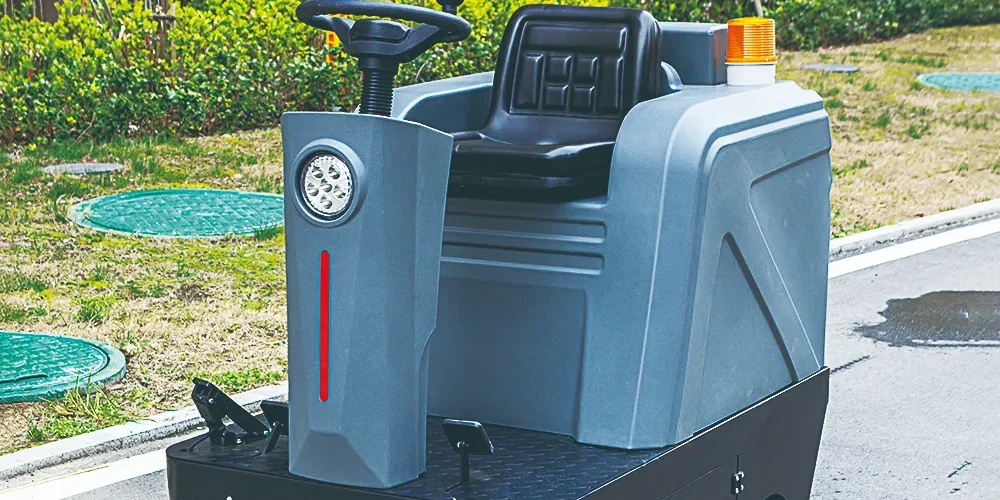
Buying an industrial floor scrubber is a capital decision that affects labor budgets, cleaning quality, and workplace safety for years. In 2026 the market offers more choices than ever — walk-behind and ride-on machines, lithium-ion and lead-acid power, disc and cylindrical brush decks — so the fastest way to narrow the field is to compare every machine on the same five specifications. This guide from OLIFT explains each one and shows how to run the numbers for your own facility.
1. Productivity Calculation: m²/h vs. Square Footage
Productivity is the single most useful number when comparing scrubbers, because it tells you how many labor hours a machine will save. Theoretical productivity equals the cleaning path width multiplied by travel speed. A 700 mm (28 in) ride-on scrubber traveling at 4 km/h covers roughly 2,800 m² per hour (about 30,000 sq ft/h) on paper. In the real world, turns, obstacles, and dumping reduce this by 15–25%, so plan on an effective rate near 2,300 m²/h (25,000 sq ft/h).
To size a machine, divide your total cleanable area by the effective productivity figure. A 46,000 m² (500,000 sq ft) distribution center therefore needs about 20 machine-hours per full pass — which is why a ride-on unit usually pays for itself faster than a walk-behind in large facilities. Always measure cleanable area rather than gross building area, and remember that one square meter equals 10.764 square feet.
2. Battery Technology: Lithium-ion vs. Lead-acid
Battery chemistry now drives both runtime and total cost. Lead-acid packs cost less up front but need 8–10 hours to charge, must be watered and ventilated, and typically deliver 1,200–1,500 cycles before replacement. Lithium-ion (LiFePO4) packs cost more initially yet accept opportunity charging during breaks, need no watering, hold voltage to the last 10% of charge, and last 2,500–3,000 cycles or more.
For multi-shift operations, lithium-ion usually wins: a 30-minute top-up keeps a machine in service across two or three shifts, while lead-acid forces either battery swapping or a dedicated overnight charging bay. Over a five-year horizon, the lower maintenance and longer service life of lithium can offset most or all of the price premium.
3. Tank Capacities & Downtime
The solution and recovery tanks set how long a machine can clean between refills and dumps. A typical general-purpose scrubber consumes 1.5–3 liters of cleaning solution per 100 m², so a 150 L solution tank supports roughly 5,000–7,500 m² per fill. Match that figure against your productivity rate: if it takes 20 minutes to refill, dump, and reposition, a machine that only covers 2,000 m² per tank will add an hour of unproductive downtime to an eight-hour shift.
The recovery tank matters just as much. It should be large enough to hold the dirty water without foaming over, and it must be easy to drain. Look for tanks with wide openings, a sight tube, and quick-release hoses — small design details that save minutes on every dump and hours over a year.
4. Squeegee and Brush Pressure Performance
The squeegee determines whether floors leave the machine dry. Straight squeegees are simple and cost-effective for open areas; L-shaped (curved) squeegees track better in aisles and handle tight turns without streaking. Urethane blades resist abrasion and chemicals longer than standard rubber, which reduces replacement frequency. Whenever possible, test a machine on your own floor: tile, epoxy, and polished concrete each need different blade tension.
Brush pressure governs cleaning aggression and floor safety. Disc brushes with adjustable down-pressure handle general cleaning, while cylindrical decks combine brushing and sweeping and generate greater agitation for grouted tile. Increasing pressure improves grime removal but also accelerates brush wear and can dull finished concrete, so choose a machine whose pressure can be tuned rather than fixed.
5. Total Cost of Ownership: Maintenance and Spare Parts
Purchase price is only the first line of the budget. A realistic five-year total cost of ownership includes batteries, brushes, squeegee blades, filters and hoses, labor, energy, and water. As a rule, consumables add 8–12% of the purchase price per year, and battery replacement adds a single large expense in year three or four if you choose lead-acid.
Spare-part availability is the hidden variable. A machine that sits idle for two weeks waiting on a brush motor can cost far more than the price difference between two vendors. Before you buy, confirm that the manufacturer stocks brushes, squeegees, and motors locally, publishes exploded parts diagrams, and offers technical support in your time zone. OLIFT supports every unit with documented parts lists and rapid-ship consumables.
Run these five numbers — productivity, battery chemistry, tank sizing, squeegee and brush pressure, and five-year cost of ownership — and the choice usually becomes obvious. Browse our full line of industrial floor scrubbers, sweepers, and burnishers to compare specifications side by side, or contact the OLIFT team for a free sizing calculation based on your facility’s dimensions and shift pattern.